Book Six · A Seussian Political Fable
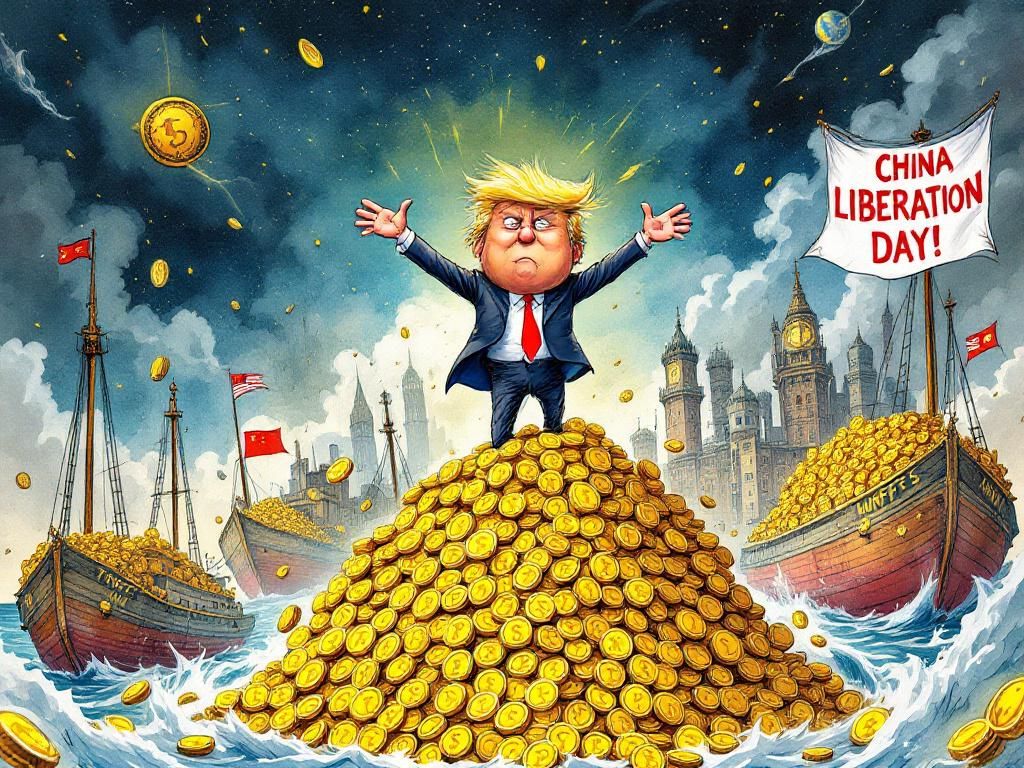
Trumpy-Wumpy on a mountain of tariff gold while the world economy crumbles

Liberation Day!
(And the Days That Followed)

Or: How Trumpy-Wumpy Declared War on Trade and Lost in Court

"Tariffs are the most beautiful word in the dictionary.
More beautiful than love. More beautiful than faith.
More beautiful than anything."
— Trumpy-Wumpy, approximately

Part One

The Trade Deficit
Is a Very Bad Thing
(Except When It Isn't)

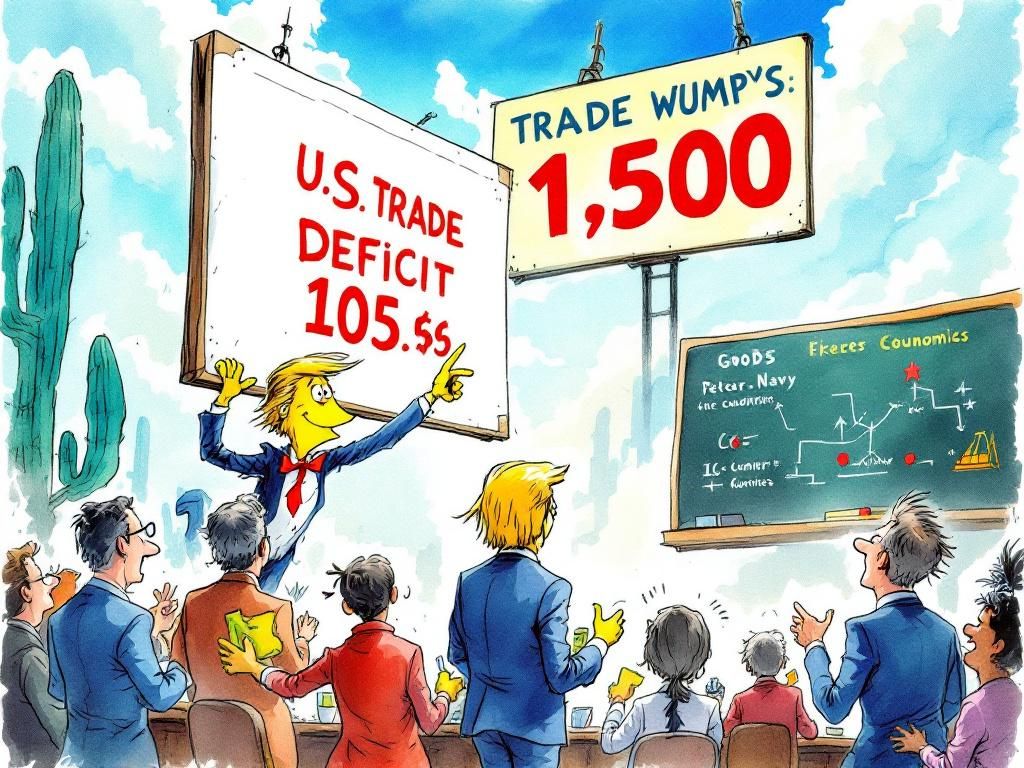
Trumpy-Wumpy and Navy-Navvy misreading the trade deficit scoreboard

Trumpy-Wumpy and the scoreboard that economists tried to explain

Now Trumpy-Wumpy had a theory, you see,

About how the trading of goods ought to be:

If America buys more than it sells to a nation,

That nation is cheating! — a clear exploitation!

The economists gathered with charts on the wall

And explained that trade deficits don't work that way at all —

That countries import what they can't make as well,

And the deficit reflects what the consumers would tell.

But Trumpy-Wumpy had Peter Navy-Navvy at hand,

Who agreed with the theory — most firmly, most grand —

And together they planned the most beautiful scheme:

Charge tariffs on everyone! That is the dream!

For tariffs, they argued, would bring the jobs back,

Fill the treasury's coffers and get America on track.

They would make other countries pay — not Bumbloo-Wee!

(The economists took notes. They disagreed. Quietly.)

The US trade deficit — buying more from other countries than selling to them — reached $1.2 trillion in 2024. Trump and Navarro treated this as evidence of cheating; most economists consider trade deficits a natural reflection of consumer demand, currency values, and comparative advantage rather than evidence of unfair trade. The Tax Foundation estimated Trump's tariffs would be "the largest US tax increase as a percentage of GDP since 1993."
Part Two

Liberation Day!
April 2, 2025

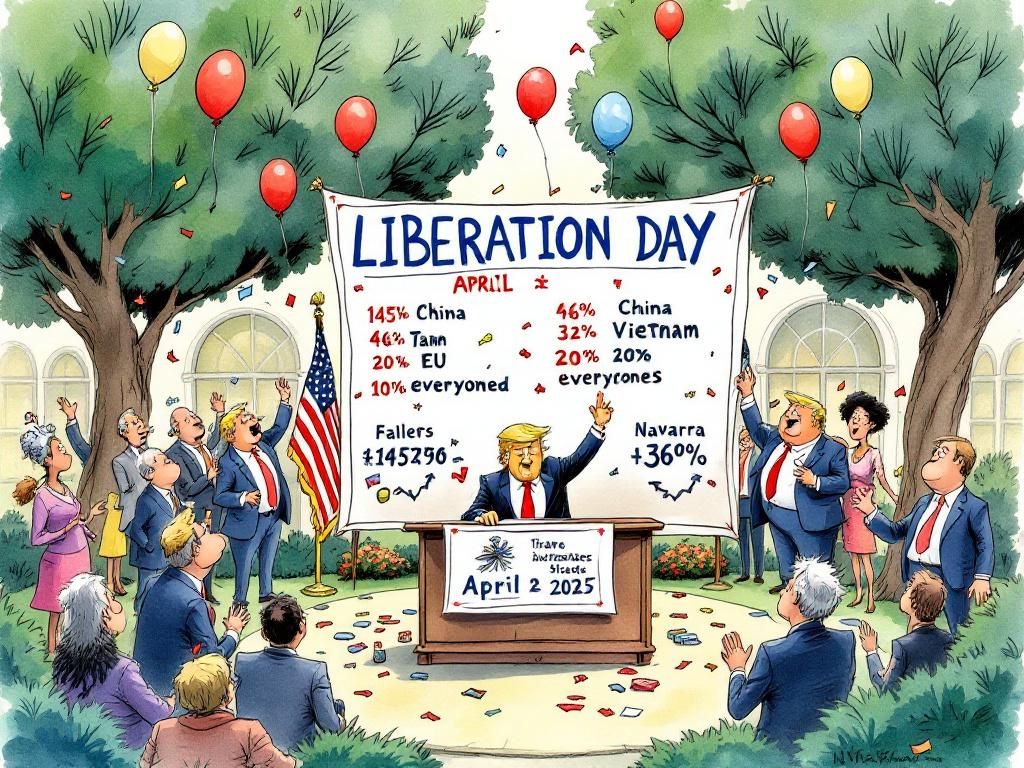
Trumpy-Wumpy's Liberation Day Rose Garden ceremony announcing reciprocal tariffs

The Rose Garden, April 2, 2025 — one of the most important days in American history (he said)

On April the Second, with great fanfare and cheer,

Trumpy-Wumpy declared it the day of the year:

"LIBERATION DAY!" he announced to the crowd,

"Our declaration of economic independence! Aloud!"

He signed an executive order most sweeping and wide,

Declaring an emergency — the trade deficit! — inside

The International Emergency Economic Powers Act,

A law never before used for tariffs. A fact.

The tariff board showed numbers wild and free:

China: 145% Vietnam: 46% Taiwan: 32% EU: 20% Everyone else: 10%

The formula that generated these remarkable rates?

Divide the trade deficit by imports — that creates

A "reciprocal" tariff — though countries noted with glee

That their actual tariffs on US goods were smaller by three.

"This is one of the most important days in American history. It's our declaration of economic independence."

— TRUMP, ROSE GARDEN, APRIL 2, 2025. The Dow Jones fell 1,679 points the next day.

The Liberation Day tariff formula divided the bilateral goods trade deficit by total imports — a method trade economists called "economically incoherent." It produced absurdly high rates for small island nations and countries with balanced trade. Even the Heard Island and McDonald Islands (uninhabited Australian territories with no exports) received a 10% tariff. The average US tariff rate hit its highest level since 1947.
Part Three

The Markets
Had Opinions

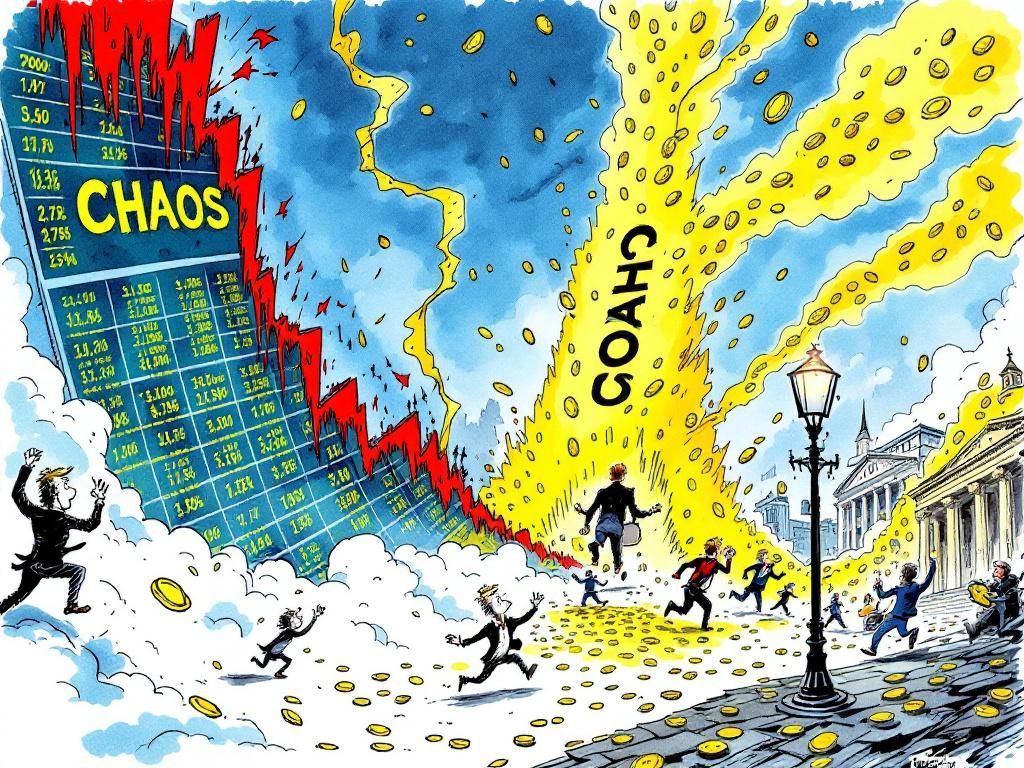
The stock market crash after Liberation Day tariff announcement

Wall Street, expressing its views in the traditional manner

The stock markets, it turned out, had thoughts of their own

About Liberation Day — mostly expressed with a groan.

The Dow Jones fell sixteen hundred points in a day.

The S&P fell three percent. Then more the next day.

Trillions of dollars evaporated from wealth

As investors assessed the new policy's health.

Even the bond market — staid, boring, and slow —

Got rattled and shook with an ominous show.

Allies around the world picked up their phones

To call the White House — and got mostly dial tones.

The administration had promised to negotiate —

But Trumpy and Navvy refused. They would wait.

Canada alleged the whole purpose, in fact,

Was to damage their economy — squeeze and extract —

To pressure them into annexation, no less.

The White House didn't disagree. More or less.

The Liberation Day announcement triggered one of the largest two-day stock market drops since the COVID pandemic, wiping out over $6 trillion in market value globally. The US bond market experienced unusual instability — typically bonds rise as a safe haven during equity selloffs. Trading partners struggled to reach the White House for negotiations; Trump and Navarro publicly stated they would not negotiate, then reversed course within days.
Part Four

The 90-Day
Oops

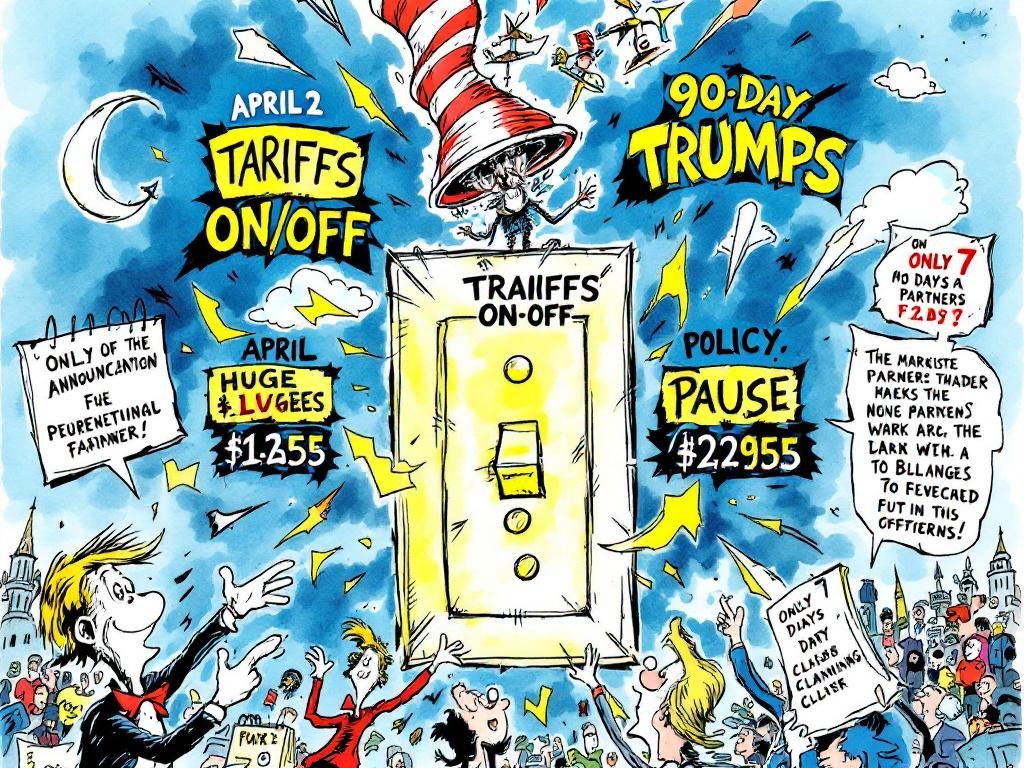
Trumpy-Wumpy's 90-day flip-flop just 7 days after Liberation Day

Seven days later, the policy that was the most important thing in history became a 90-day pause

On April the Ninth — just one week had passed —

The most important policy in history didn't last:

Trumpy-Wumpy paused most of the tariffs for ninety days,

While keeping China's at one hundred forty-five — always.

The announcement came suddenly, posted online,

Stock markets shot UP by nine percent — a fine sign!

But businesses looked at each other and said,

"Does anyone know what the policy is?" With some dread.

Feb 13
Announces reciprocal tariff plan — refuses to negotiate
Apr 2
Liberation Day — sweeping tariffs on every country
Apr 5
Tariffs go into effect
Apr 9
90-day pause announced — most tariffs dropped to 10%
Jul 7
90-day pause extended again to August 1
Aug 7
Tariffs ordered to resume — then more negotiations

The policy flipped. Then it flopped. Then it flipped back again.

Trade deals were announced — then extended — and then

Extended once more — bilateral frameworks agreed —

A permanent solution? Still waiting, indeed.

Trump's April 9 pause came after significant bond market instability and stock market declines. The S&P 500 rose 9.5% in one day after the pause was announced — its best day since 2008. The 90-day pause was extended on July 7 through August 1, then tariffs were ordered to resume August 7. By year end, no comprehensive deals had been finalized with major trading partners, leaving businesses in prolonged uncertainty about future tariff levels.
Part Five

The China Problem:
145% vs 125%

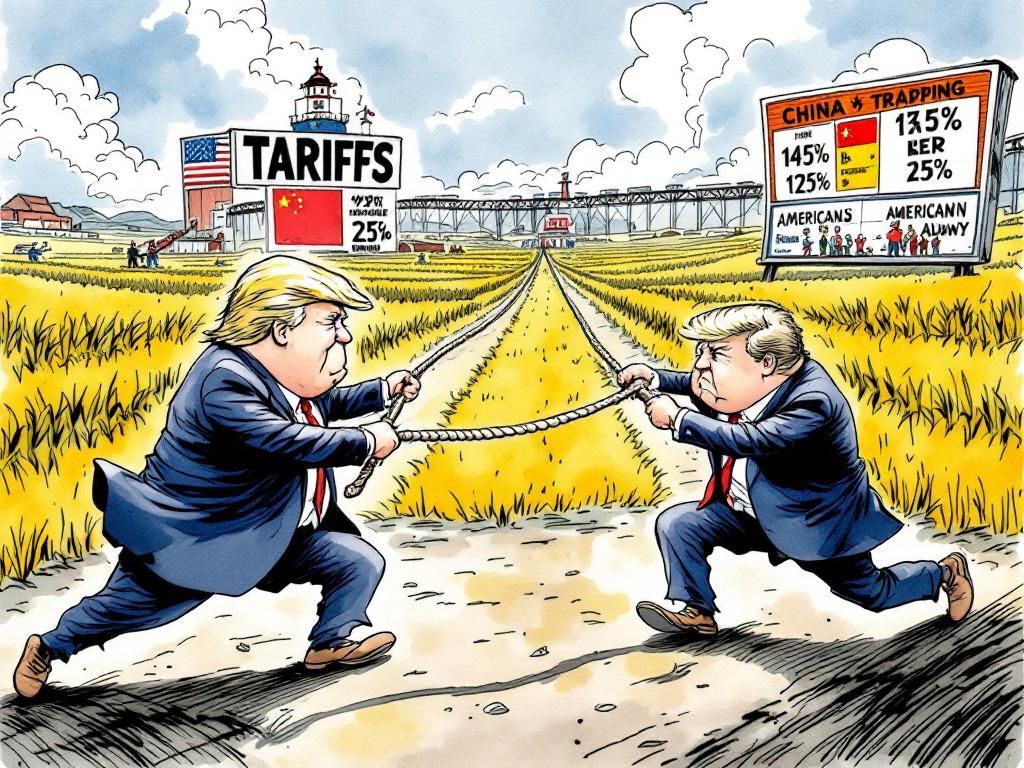
The US-China tariff escalation war reaching 145% vs 125% retaliation

The world's two largest economies, expressing trade policy through escalation

Now China was different from all of the rest —

The pause did not apply there. They would be the test

Of Trumpy-Wumpy's toughness and maximum pain:

One hundred forty-five percent! Again and again!

China replied with one hundred twenty-five percent back,

Retaliating fully — quite a tit-for-tat track.

American soybeans? China stopped buying those.

American pork? Same. American aircraft? It goes.

At 145 percent the trade had effectively stopped —

Like a wall had been built and the commerce had flopped.

Ships that had crossed the Pacific for decades stayed docked.

American farmers watched their export markets get knocked.

Then a temporary truce! Then another extension!

Then more negotiations with maximum tension.

The world's two largest economies played chicken most fine

While their citizens paid at the checkout line.

China faced 145% total US tariffs (including pre-existing duties) and responded with 125% retaliatory tariffs on US goods. China halted purchases of US soybeans, corn, pork, and aircraft. US farm exports to China fell sharply. A temporary truce was announced in May 2025, then extended multiple times. The Peterson Institute estimated the tariffs reduced US and global economic growth and increased inflation, disproportionately hurting US agriculture and manufacturing.
Part Six

Friends, Enemies,
and the 10% That Applied to Both

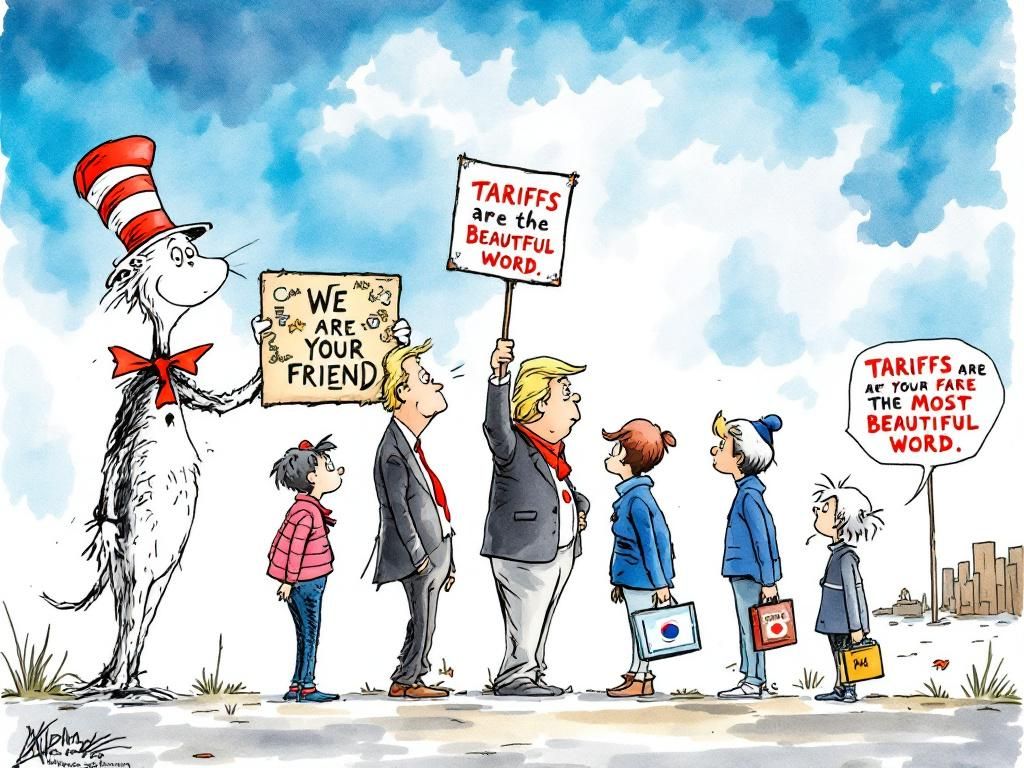
Allied nations Canada EU Japan Korea shocked to receive same tariffs as adversaries

Canada, having been a friend for 150 years, learning something new about the relationship

Now one curious feature of Trumpy-Wumpy's grand plan

Was that friends got the tariffs as well as the clan

Of adversaries, rivals, and less-friendly nations —

Ally or enemy? Same tariff. No graduations.

Canada — neighbor and friend since the nation began —

Got twenty-five percent tariffs under a fentanyl ban,

Plus extra on steel and aluminum most fine.

Canada alleged this was pressure to cross the border line.

The European Union — democratic ally —

Got twenty percent tariffs, then thirty. Oh my.

Japan, South Korea, the UK — friends all —

Waited in uncertainty for the tariff axe's fall.

NATO allies found their trade was being squeezed

While Trumpy-Wumpy praised Putin and seemed rather pleased.

The message to the world was quite clear to see:

Being America's friend is no guarantee.

Canada alleged the tariffs were designed to damage its economy and pressure annexation — an accusation the White House did not deny. The EU faced 20% tariffs (later threatened at 30%) and prepared retaliatory measures. Japan, South Korea, Australia, and other treaty allies all faced tariffs. Canada PM Carney said "the old relationship with the US is over." Steel and aluminum tariffs of 25% applied globally, including NATO allies.
Part Seven

Who Actually
Paid the Tariffs

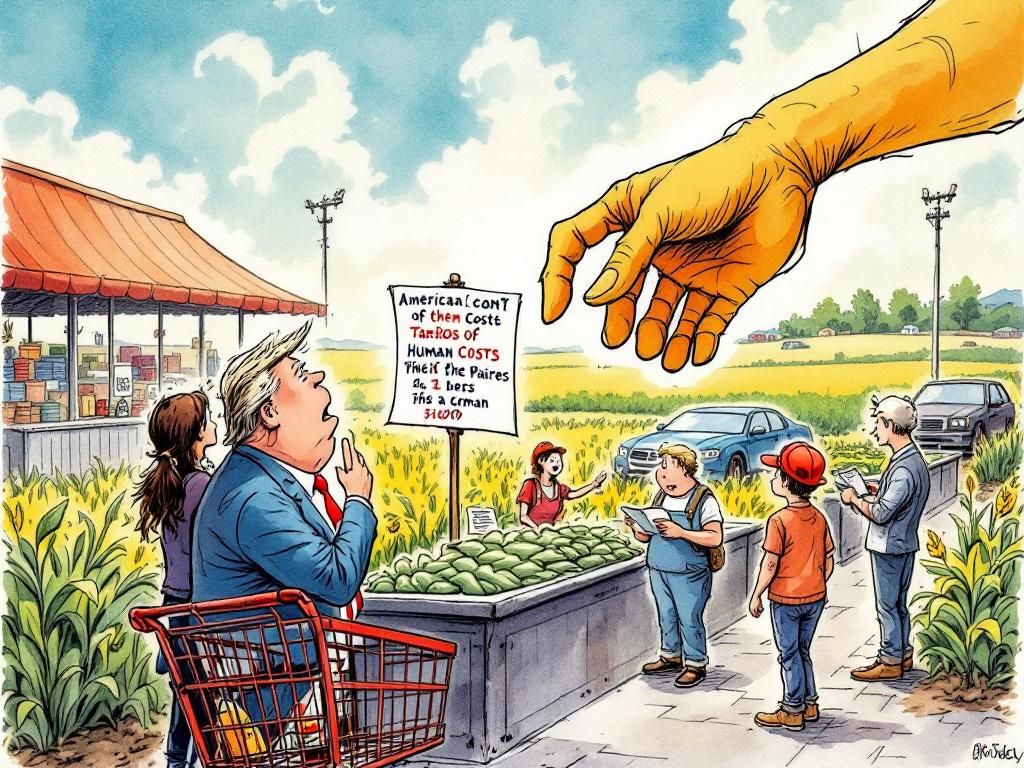
American families, farmers and workers paying the price of the tariff war

The American consumer, discovering that tariffs are taxes on themselves

Now here is the part that requires explanation,

Since Trumpy-Wumpy said it most firmly across the nation:

"Other countries will PAY! They will pay every cent!"

But here is what actually happened, and went:

A tariff is paid by the importer, you see —

The American business that's buying, not the country set free.

And businesses, finding their costs have gone up,

Pass them along to the consumer's cup.

The average American household, by year's end fine,

Had paid one thousand dollars extra — that's the line.

Washing machines, cars, electronics, and more

All rose in price at the grocery and store.

American farmers — who'd voted for Trumpy with hope —

Found China had stopped buying their exports. They'd mope

As soybean prices fell and fields went unsold

And the government bailout programs grew bold.

The Tax Foundation estimated Trump's 2025 tariffs amounted to an average tax increase of $1,000 per US household. Tariffs on steel raised prices for every US industry that uses steel. Consumer electronics, appliances, and clothing prices rose. US farmers lost Chinese export markets worth $26 billion annually. The administration allocated $23 billion in farm subsidies to offset losses — paid by taxpayers. The trade deficit barely changed.
Part Eight

The Court Says:
"You Can't Do That"

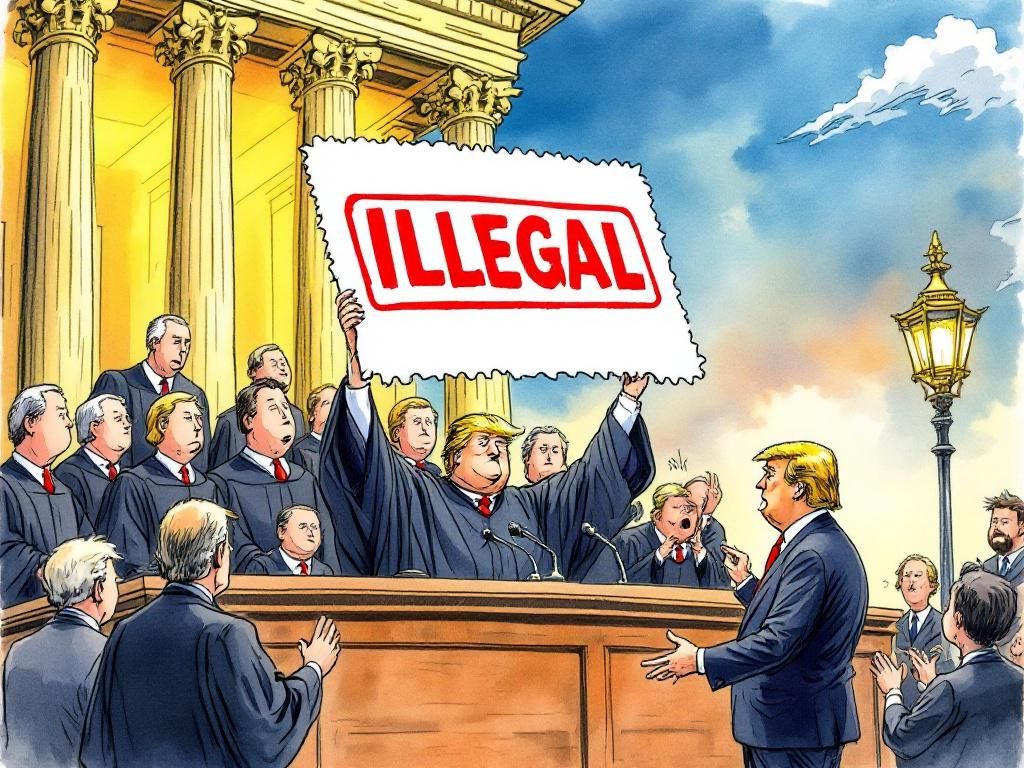
Supreme Court ruling IEEPA tariffs unconstitutional requiring $166 billion refund

The Supreme Court, February 2026, explaining the limits of emergency economic powers

Now seven lawsuits had challenged the legal foundation

Of using IEEPA for tariffs across the nation.

The argument: Congress had never intended that law

To give presidents unlimited tariff claw.

The Court of International Trade agreed in May Twenty-Five.

The Federal Circuit agreed in August. Still alive

Were appeals — until February Twenty-Six came along

And the Supreme Court ruled six to three: the tariffs were wrong.

One hundred sixty-six billion dollars had been collected

From three hundred thirty thousand businesses affected.

Now it would have to be returned — refunded — paid back.

The government said: sue us. There's no automatic track.

And Trumpy-Wumpy, undaunted, announced with great cheer

New tariffs under different authority — never fear!

Section 122! Ten percent for a hundred fifty days!

The courts prepared their briefs. The chaos continues to blaze.

The Supreme Court ruled 6-3 in February 2026 that IEEPA does not authorize tariffs, calling the administration's interpretation unprecedented. $166 billion in collected tariffs had to be refunded to 330,000+ businesses. The DOJ argued companies must file individual lawsuits rather than receive automatic refunds. Trump immediately imposed 10% tariffs under Section 122 of the Trade Act — its own legal authority — for 150 days, threatening to raise to 15%.
Part Nine

The Trade War
Ledger

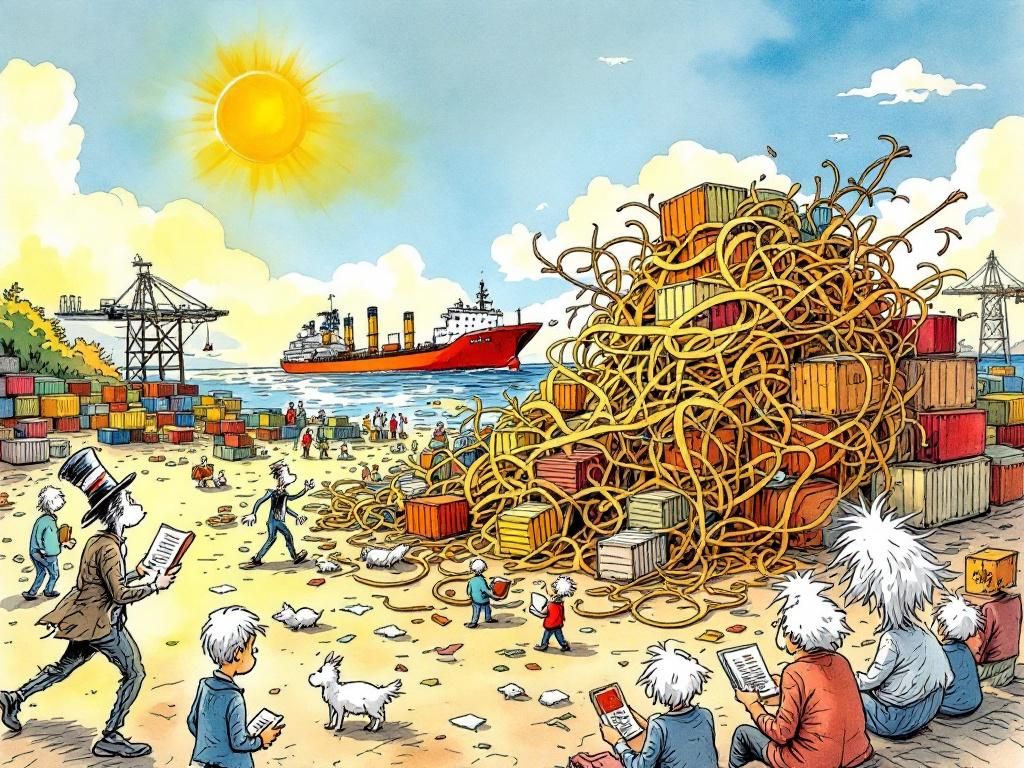
The world trading system battered but surviving the tariff chaos

The trading world, battered but still trading

And so, when the ledger of Liberation Day

Was balanced and totaled at year's turning away:

The trade deficit? Barely reduced by a sliver.

The manufacturing jobs? Not returned to the river.

The average tariff rate? Highest since Forty-Seven.

The consumer cost? About a grand — not heaven.

The allies? Confused, resentful, and bruised.

The markets? Volatile, uncertain, confused.

The legal authority? Struck down by the court.

The refunds owed? One hundred sixty-six billion short.

But Trumpy-Wumpy declared it a victory, grand!

The greatest trade achievement in all of the land!

He announced new tariffs with new legal ground

While the courts sharpened pencils and made a new sound.

The lesson the textbooks will write, by and by:

When policy chaos replaces consistent supply

Of clear rules and norms in the global trade game,

The businesses, workers, and farmers all pay — just the same.

Unless someone cares — really, truly, a lot

The Bumbloo-Wee world will keep going to rot.

— THE END —

(the tariff saga, however, has not ended)

This is a work of political satire. All tariff rates, dates, court rulings, economic figures,
and market reactions cited are drawn from public record and published sources.
The Seussian framing is fictional. The $166 billion refund is not.
The author maintains no personal grudge against tariffs per se,
only their application to uninhabited territories.